What to expect
CAyS is jointly planned with a local Planning Committee of community leaders, residents, schools, agencies and other safety partners over the course of two to three months. During the workshop, the Project Team reviews local crash data and the community’s traffic safety experiences, reviews an adapted Safe System Approach framework and pedestrian and bicycle safety best practices, guides participants on a walking and biking safety assessment, facilitates action planning with community members, and engages participants during a lotería activity that uses Safe System Approach strategies. The CAyS program is committed to equitable and accessible community outreach and engagement in active transportation planning. We prioritize working in communities that are at higher risk for road traffic injuries and addressing the safety needs of people who are underserved by traditional transportation planning and resources. Through collaborative work, the program helps build rapport between residents, local officials, agency staff, coalitions, and other stakeholders.
Activities may include
-
Safe System Approach presentation: A presentation of an adapted Safe System Approach, including its principles, layers of protection, and strategies to eliminate fatal and serious injuries on the road;
-
Pedestrian and bicyclist crash overview: Analysis and presentation of crash data in the community’s focus area and crash trends to identify causes and potential solutions to active transportation safety challenges;
-
Walking and biking assessment: An assessment of pedestrian and bicyclist safety conditions, concerns, and road user behavior patterns around selected routes conducted either in the field or as a table-top activity;
-
Action planning: An interactive activity with local residents and safety advocates to develop a community-driven action plan to improve walking and biking safety in their communities;
Communities can use this training to
-
Support grant applications for infrastructure and community education programs;
-
Implement education efforts;
-
Build or strengthen local coalitions;
-
Increase understanding of effective policy change approaches;
-
Expand outreach within communities; and
-
Explore and implement Safe Routes to School programming.
Interested in learning more about the program or an upcoming training? Please contact us atcpbsp@berkeley.edu
Research and program evaluation
The CPBSP team reviews the program and its impact on a regular basis. Please see below for a list of recent follow-up surveys, research briefs, and an evaluation of the effectiveness of the CPBSP:
- Pairing Speed Limit Reductions and Infrastructure to Lower Fatal and Serious (FSI) Crashes. Noelani Fixler, Melie Ekunno (2025).
-
Community Pedestrian and Bicycle Safety Training (CPBST) Program Workshop Follow-Up Survey Highlights: 2024 | 2023 | 2022 | 2021 | 2020
-
Connecting Public Health and Transportation - Applying Crowdsourcing and Community Engagement Principles to Traffic Safety. Jarah Crowner, Katherine L. Chen (2024).
-
Equitable Transportation Planning for Pedestrian and Bicycle Safety through the Use of the Safe System Approach. Noelani Fixler, Lucia Ornelas, Kris Leckie (2024).
-
Mobility Safety for California's Affordable Housing Residents: Co-locating Improvements. Kyler Blodgett (2024).
-
Peer Exchange Series 2024: My community is eager to collaborate and grow! Where do we go from here? Areli Ariana Balderrama (2024).
-
2023 CPBSP Annual Report. Katherine L. Chen (2023).
-
Toward a Better Understanding of Best Implementation Practice for the Community Pedestrian and Bicycle Safety Training Program. Aqshems Nichols, Areli Ariana Balderrama, and Katherine L. Chen (2023)
-
Conducting Community Engagement with a Safe System Lens. Katherine L. Chen and Jill F. Cooper (2021).
-
How effective are community pedestrian safety training workshops? Short-term findings from a program in California. Jesus M. Barajas, Kate M. Beck, Jill F. Cooper, Ana Lopez, Amanda Reynosa (2019).
- Community Pedestrian and Bicycle Safety Training Program Evaluation Report. Sarah Doggett, Kate M. Beck, Ana Lopez, Jill F. Cooper (2019).
Implementing the Safe System Approach Toolkit

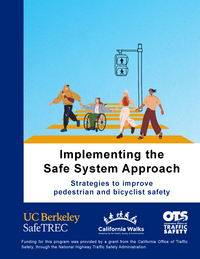
Explore our toolkit, available in English and Spanish, which aims to help create safer communities for walking and biking across California through the use of the Safe System Approach. The toolkit contains potential Safe System strategies which are organized into key categories and can be easily navigated using listed keywords.
There are many ways to plan a bikeable and walkable community; this toolkit is just a starting point.
Download the full toolkit:
Los Caminos de las Vías: RadioNovelas
From 2021-2024, CAyS workshop participants created RadioNovelas, podcasts that highlight community concerns and propose solutions through the power of storytelling. These audio-visual projects were intended to be used as a tool for advocacy to create their local community visions for a healthy, walkable, and bikeable community. A RadioNovela episode developed from a workshop held in Tulare in 2024 highlighted the experience of community members and students walking and biking to school. Participants shared that they are in need of infrastructure, such as complete sidewalks, high-visibility crosswalks, and traffic-calming measures, to ensure the safety of students walking and biking to and from Roosevelt Elementary School and Alice Mulcahy Middle School. This episode and all past Camino de las Vias podcasts can be found on Soundcloud.
Funding for this program was provided by a grant from the California Office of Traffic Safety (OTS) through the National Highway Traffic Safety Administration (NHTSA).


