Bicycle safety

Report Pedestrian and Bike Safety Issues in the Bay Area

August 24, 2017

Crowdsourced data of bike and safety issues

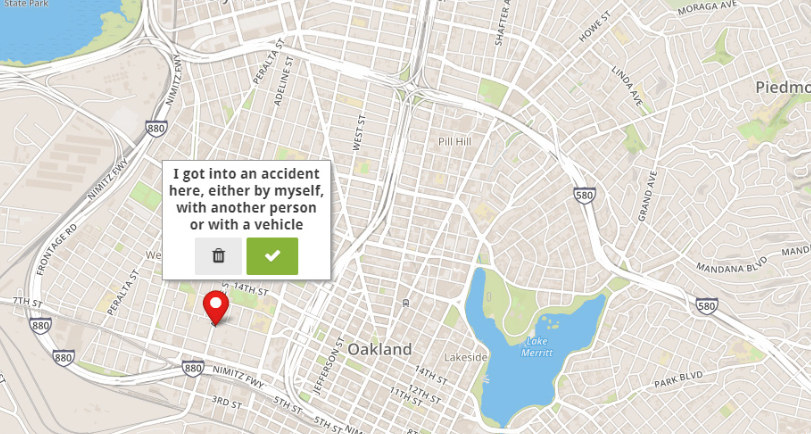
As a bicyclist or pedestrian, have you been hit or almost hit by a car, truck, motorcycle or bicycle? Do you generally feel unsafe when biking/walking in The Bay Area? Report pedestrian and bike safety issues for one month for a chance to win a gift card and help city officials and researchers understand how to use crowdsourced data to address safety...

Free Pedestrian and Bicycle Safety Workshops

June 6, 2017

SafeTREC and California Walks are happy to announce that we are offering free Community Pedestrian and Bicycle Safety Training (CPBST) workshops across the state this summer. The goal is to make communities safer and more pleasant for walking and bicycling. Join us this month in Oakland, Merced, El Dorado County, and Palermo. We are still recruiting sites to host CPBST workshops. If you are interested, please submit this intake form. ...

Bicycle Infrastructure that Extends beyond the Door: Examining Investments in Bicycle-oriented Design through a Qualitative Survey of Commercial Building Owners and Tenants

Orrick, Phyllis
Frick, Karen Trapenberg
Ragland, David R.
2011

This paper presents the results of a qualitative survey of commercial owners, managers, and occupants in the City of Berkeley who have invested in on-site bicycle facilities such as secure parking, showers, changing rooms, and clothing lockers, what we are calling “bicycle-oriented design” (BOD). The sites represent a selection of building types common in the commercial building stock in U.S. cities. The research is designed to answer three questions about the use of BOD: (1) what were motivations behind the decision to invest in BOD (2) what are the challenges and rewards for...

Strategies for Reducing Pedestrian and Bicyclist Injury at the Corridor Level

Ragland, David R.
Grembek, Offer
Orrick, Phyllis
2011

Methods for identifying sites with potential for preventing traffic fatalities and injuries have been developed for vehicle-vehicle collisions. This study was funded by the California Department of Transportation (Caltrans) to develop methods for identifying sites where there is potential for significant reductions in pedestrian and bicyclist injury. Data from 1998-2007 from a 16.5-mile section of San Pablo Avenue (SR 123) in the San Francisco East Bay was used as a study area. Several approaches for identifying sites with high potential for reducing pedestrian and bicyclist injury were...

Community Pedestrian Safety Training: Action Plans

October 29, 2015

Our Community Pedestrian Safety Training (CPST) program with California Walks is a four-hour, community-based workshop designed to help local advocates and community members develop pedestrian safety action plans that leverage best practices, promote walkability and ensure community engagement.

This year, we were honored to work with nine communities all across the state, including the Hoopa Valley Tribe, McKinleyville, Pasadena, Redding, Ukiah, Tule River Tribe, Fresno, Crenshaw & Leimert Park and...
Rosemont CPBST: Wednesday, April 19

April 10, 2017

Join us on Wednesday, April 19 for another Community Pedestrian and Bicycle Safety Training (CPBST) at Einstein Middle School in Rosemont!

TRAINING INFORMATION
DATE/TIME: Wednesday April 19 ; 10AM- 3PM
LOCATION: Einstein Middle School - 9325 Mirandy Drive Sacramento, CA 95826
REGISTRATION: bit.ly/Rosemont_Workshop

Do All Roadway Users Want the Same Things?

Sanders, Rebecca L.
Cooper, Jill F.
2013

This paper presents findings from a recent study on roadway design preferences among pedestrians, drivers, bicyclists, and public transit users along a major urban corridor in the East San Francisco Bay Area. Sponsored by the California DOT, the research focused on exploring design preferences that could increase perceived traffic safety, walkability, bikability, and economic vitality along urban arterials. Results from an intercept survey showed that all user groups desire similar roadway design features along the test corridor, which carries 25,000-30,000 motorists bi-directionally...

Safe Routes to School Local School Project: A health evaluation at 10 low-income schools

Cooper, Jill F.
McMillan, Tracy
2010

The Safe Routes to School National Partnership (Partnership) founded the Local School Project (Project) in 2008 to assist ten schools in lowincome communities to: 1) develop and evaluate a school-based SRTS program, 2) build local capacity to apply for state or federal SRTS funding, and 3) increase safe walking and bicycling to and from the school and in the community. The Centers for Disease Control and Prevention, Kaiser Permanente, and the Robert Wood Johnson Foundation provided funding for the Project. This report presents the results, lessons learned and recommendations...

Performance Measures for Complete, Green Streets: Initial Findings for Pedestrian Safety along a California Corridor

Sanders, Rebecca L.
Macdonald, Elizabeth
Anderson, Alia
Ragland, David R.
Cooper, Jill F.
2011

This paper reports on research conducted by the Safe Transportation Research and Education Center and sponsored by the California Department of Transportation (“Caltrans”) to establish performance measures for pedestrian and bicycle safety and mobility along urban arterials. Although historically focused on motorized vehicle mobility, Caltrans has recently joined in a national trend to incorporate non-motorized transportation and community-level outcomes into transportation decision-making frameworks, an approach known as "Complete Streets." Recognizing that its current performance...